
Rest & Recovery Explained
Training creates the signal for adaptation. Rest and recovery determine whether that signal turns into progress.
Many people focus on effort while overlooking the biological phase where change actually happens.
This page explains what rest and recovery mean, why they matter, and how they influence long term results, using simple, science informed language.
This content is educational, not medical advice.

What Rest and Recovery Really Are
Rest is not inactivity.
Recovery is not laziness.
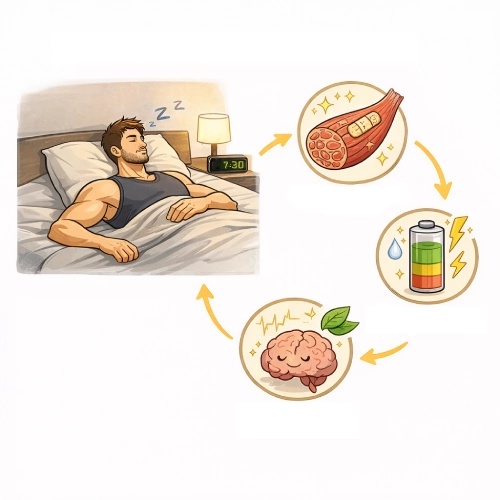
From a biological perspective, recovery is the period when the body:
- Repairs stressed tissue
- Restores energy systems
- Rebalances the nervous system
Training applies stress. Recovery decides how the body responds to that stress.
Without sufficient recovery, the body shifts from adaptation to protection.
Why Muscles Do Not Grow During Training
Resistance training creates microscopic disruption and fatigue. That is only the trigger.
Research shows that muscle protein synthesis increases after training and remains elevated for a limited time. Growth occurs when this rebuilding process consistently exceeds breakdown over repeated cycles.
In simple terms:
- Training sends the message
- Recovery delivers the result
Sleep as the Foundation of Recovery
Sleep is the most powerful recovery tool available.
During sleep:
- Growth related hormonal signals increase
- Tissue repair accelerates
- Neural fatigue decreases
Scientific evidence suggests that insufficient sleep can reduce muscle protein synthesis, impair performance, and increase perceived effort during training.
Sleep does not make training optional, but poor sleep can make training less effective.
Nervous System Fatigue Matters Too
Recovery is not only about muscles.
The nervous system adapts to training stress as well. High effort, heavy loads, and frequent failure training place demand on neural resources.
When neural fatigue accumulates:
- Coordination declines
- Strength expression drops
- Training quality suffers
This is one reason why progress can stall even when motivation is high.
Active Recovery vs Complete Rest
Recovery exists on a spectrum.
Complete rest involves minimal physical stress.
Active recovery involves low intensity movement that promotes circulation without adding fatigue.
Research suggests that light activity can support recovery by:
- Improving blood flow
- Reducing stiffness
- Supporting mental recovery
The key is that active recovery must remain easy enough to recover from.

Why More Recovery Is Not Always Better
Just as too much training can slow progress, excessive rest can reduce training stimulus.
Adaptation depends on balance:
- Too little recovery leads to accumulated fatigue
- Too much recovery reduces exposure to meaningful stress
The goal is not maximum rest. It is sufficient recovery.
Individual Recovery Differences
Recovery capacity varies between individuals.
Factors that influence recovery include:
- Training history
- Age
- Sleep quality
- Life stress
- Nutrition and energy intake
This explains why identical training plans can produce different outcomes. Recovery is personal biology, not a fixed rule.
A Clear Way to Think About Recovery
Instead of asking:
- “Did I rest enough?”
A more useful question is:
- “Can I repeat this level of training with similar quality?”
If performance, focus, and movement quality are consistently declining, recovery is likely insufficient.
Why Recovery Is Often Ignored
Recovery is quiet.
It does not feel productive.
It is not visible on social media.
Because of this, many people undervalue it even though research consistently shows it plays a central role in adaptation.
Understanding recovery shifts the focus from constant effort to sustainable progress.
Rest and recovery are not breaks from progress.
They are the conditions that allow progress to happen.If you want, the next natural topic here is Failure Training, where recovery becomes the limiting factor very quickly.
Selected Scientific Reading
Only a few references are needed here to support the core ideas:
- Phillips, S. M., Van Loon, L. J. (2011). Dietary protein for athletes: From requirements to metabolic advantage.
https://pubmed.ncbi.nlm.nih.gov/22150425/ - Dattilo, M. et al. (2011). Sleep and muscle recovery: Endocrine and molecular basis for a new and promising hypothesis.
https://pubmed.ncbi.nlm.nih.gov/21366049/ - Halson, S. L. (2014). Monitoring training load to understand fatigue in athletes.
https://pubmed.ncbi.nlm.nih.gov/25028706/