
Training Splits Explained
Training splits describe how training stress is distributed across days, not which exercises are chosen. They are often treated as identities or labels, but biologically they are simply organizational frameworks that shape recovery, fatigue, and repeatability.
This page explains what training splits are, why they exist, and how to think about them, without prescribing routines or telling you what to follow.
This content is educational, not medical advice.
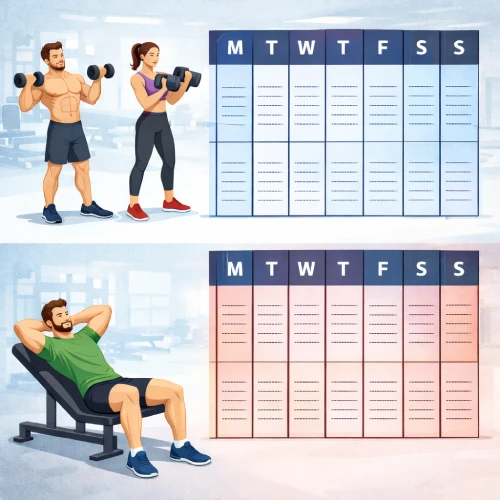
What a Training Split Really Is
A training split answers one question:
How is weekly stress arranged across time?
It determines:
- Which muscles are trained together
- How often each muscle is exposed to stress
- How fatigue and recovery are spaced
A split does not change biology. It changes timing.
Two people can do the same total work in a week and adapt differently if that work is arranged differently.
Why Training Splits Exist
Splits emerged as a response to practical constraints:
- Limited recovery capacity per session
- Time availability across the week
- Accumulated fatigue when training everything at once
Instead of increasing effort endlessly in one session, splits distribute stress so the body can recover and repeat.
Splits are solutions to scheduling problems, not shortcuts to faster growth.
Common Split Types and What They Emphasize
Different splits emphasize different trade-offs.
Full-body splits
- Spread stress across the entire body in one session
- Emphasize frequent exposure with lower per-session fatigue
Upper/lower splits
- Separate upper and lower body stress
- Allow more focused work while managing recovery
Push/pull/legs splits
- Group muscles by movement patterns
- Distribute fatigue across related systems
None of these create unique adaptations by themselves. They simply organize stress differently.

Frequency, Volume, and Splits
Splits are closely tied to training frequency, but they are not the same thing.
Frequency refers to how often a muscle is trained.
Splits describe how that frequency is achieved.
Research suggests that when weekly volume is matched, different split structures can produce similar outcomes. What changes is how manageable the workload feels and how consistently it can be repeated.
Fatigue Management Is the Real Variable
The main effect of a split is how fatigue accumulates.
Splits influence:
- Session length
- Local muscle fatigue
- Nervous system stress
A split that overwhelms recovery will stall progress regardless of how popular it is. A split that respects recovery can work even if it looks simple.
Biology responds to recoverable patterns, not labels.
Why People Get Confused by Splits
Splits are often marketed as identities:
- Beginner split
- Advanced split
- Optimal split
This framing creates false hierarchies.
In reality, a split that works well in one context may work poorly in another. Research consistently shows that adherence and recovery matter more than split complexity.
A Better Way to Think About Training Splits
Instead of asking:
- “Which split is best?”
A more useful question is:
- “How does this split distribute stress and recovery across my week?”
This reframes splits as logistical tools, not performance guarantees.

When a Split Stops Working
A split usually stops working not because it is wrong, but because:
- Total stress has increased
- Recovery capacity has changed
- Life demands interfere with consistency
Understanding this prevents unnecessary program hopping and frustration.
Why Understanding Splits Matters
When training splits are misunderstood, people often:
- Change structure too often
- Copy schedules without context
- Blame themselves instead of organization
Understanding splits restores perspective. It makes training interpretable rather than mysterious.
Once training splits are understood as tools rather than rules, attention naturally shifts to how individual sessions are built.
Structure at the workout level determines how well a split actually functions in practice.That layer is explored in How to Structure a Workout, where exercise order, workload flow, and session design are examined in detail.
Selected Scientific Reading
Only a small number of sources are needed to support the main ideas:
- Schoenfeld, B. J. et al. (2016). Effects of resistance training frequency on measures of muscle hypertrophy.
https://pubmed.ncbi.nlm.nih.gov/27102172/ - Grgic, J. et al. (2018). Effects of resistance training frequency on strength gains.
https://pubmed.ncbi.nlm.nih.gov/29470825/ - American College of Sports Medicine. Progression models in resistance training for healthy adults.
https://pubmed.ncbi.nlm.nih.gov/19204579/