
Training Volume & Intensity Explained
Two words shape almost every training plan: volume and intensity. Most confusion in bodybuilding training comes from mixing them up, treating them as the same thing, or trying to max both at the same time.
This page explains what training volume and intensity mean, how they interact, and why the “more is always better” mindset often backfires.
This content is educational, not medical advice.

What “Training Volume” Means
Training volume is the total amount of work you perform.
In practice, it’s often discussed as:
- Hard sets per muscle per week (a common, simple method)
- Total sets in a session
- Sometimes “volume load” (sets × reps × load)
For muscle growth discussions, research frequently uses weekly sets per muscle group as a practical indicator of volume. Studies suggest there is a dose-response trend: more weekly sets tends to produce more hypertrophy, up to a point.
What “Training Intensity” Means
Intensity can mean two different things, which is why people get confused:
1) Load intensity
How heavy the weight is relative to your max (often expressed as % of 1RM).
2) Effort intensity
How close the set is taken to your true limit (how many reps you had left in reserve).
In bodybuilding conversations, people often talk about “high intensity” but actually mean high effort (training close to failure), not necessarily heavy weights.
The Simple Relationship
- Volume is how much.
- Intensity is how hard (or how heavy).
They trade off in real life:
If intensity is very high (very heavy or always to failure), the amount of volume you can recover from usually decreases. If volume is very high, intensity often needs to be managed.
This is why training can feel “hard” but still be poorly designed: the stress may be high, but not recoverable.

Volume and Hypertrophy: Why Sets Matter
A lot of people search for the “perfect rep range,” but research suggests weekly volume is one of the strongest predictors of hypertrophy when other factors are reasonable. Meta-analytic data indicates higher weekly set volumes generally lead to greater muscle growth, with larger effects seen when weekly sets exceed lower ranges (for example, comparing very low set volumes to higher ones).
That said, more is not infinite. The same body that adapts also protects itself when fatigue gets too high.
A useful way to think about it:
- Enough volume → growth signal
- Too much volume → recovery problem
Intensity and Hypertrophy: Heavy Isn’t the Only Tool
Heavy training is effective, but it is not the only pathway to hypertrophy.
Evidence suggests muscle growth can occur across a range of loads when sets are performed with sufficiently high effort. A large part of the “hypertrophy signal” is driven by mechanical tension and recruitment of muscle fibers, which can happen with different loading strategies.
So the key question becomes less about “heavy vs light,” and more about:
- Was the set challenging enough?
- Was the total weekly stimulus high enough?
- Can you repeat it consistently?
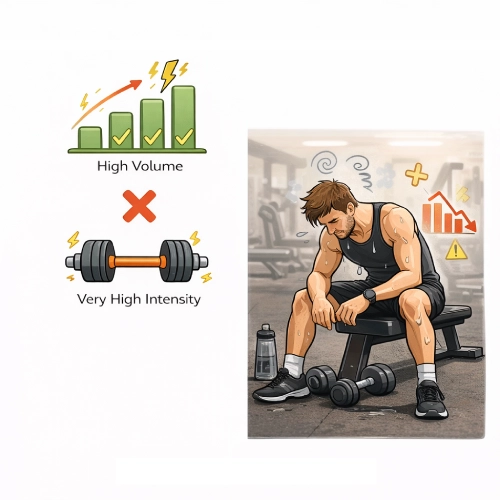
Why People Get Stuck: The “Max Both” Trap
A very common pattern is trying to do:
- high volume
and - very high intensity (heavy + to failure + minimal rest)
This often creates a fatigue problem instead of a growth problem.
Over time, performance drops, technique worsens, and the actual training stimulus becomes less productive. The body becomes busy managing stress instead of building new tissue.
A Clear Way to Interpret Effort
Because effort is hard to measure, many lifters use simple scales like reps in reserve (RIR) or RPE-based effort rating.
These methods are not perfect, but research supports them as practical tools to manage how close you train to failure—especially when fatigue changes day to day.
The point is not the scale itself.
The point is learning to separate:
- “This felt hard”
from - “This was the right dose of stress”
How to Think About Volume and Intensity Together
Instead of chasing the “hardest” session, it’s more useful to think in terms of repeatable weeks.
A training week works when:
- You can perform enough quality sets (volume)
- You can keep effort meaningful (intensity)
- You can recover and repeat it
This is why some people make steady progress on “less exciting” training: it is sustainable and repeatable.
Why This Matters for Long-Term Progress
Most plateaus are not caused by “bad genetics” or “wrong exercises.” They are caused by mismatched stress:
- Volume too low → not enough signal
- Intensity too low → not enough effort
- Both too high → recovery breaks
Understanding volume and intensity gives you a way to interpret training logically rather than emotionally.
Understanding how volume and intensity shape training stress also raises a practical question.
If both variables influence adaptation, how often that stress is applied becomes just as important as how hard or how much.That connection is examined in Training Frequency, where recovery capacity and stimulus timing explain why distribution matters as much as load.
If You Want the Research
A small set of sources is enough here—just to anchor the key claims:
- Schoenfeld, B. J. et al. (2017). Dose-response relationship between weekly resistance training volume and increases in muscle mass.
https://pubmed.ncbi.nlm.nih.gov/27433992/ - Schoenfeld, B. J. et al. (2019). Resistance training volume enhances muscle hypertrophy but not strength in trained men.
https://pubmed.ncbi.nlm.nih.gov/30153194/ - ACSM (2009). Progression Models in Resistance Training for Healthy Adults.
https://pubmed.ncbi.nlm.nih.gov/19204579/ - Helms, E. R. et al. (2016). Repetitions-in-Reserve based RPE scale for resistance training.
https://pmc.ncbi.nlm.nih.gov/articles/PMC4961270/