
Vitamins & Minerals
Why small molecules matter, and why more rarely means better
Vitamins and minerals are often treated as background details in nutrition. They do not provide energy, they do not build muscle tissue directly, and they rarely create immediate, noticeable sensations. Yet without them, nearly every biological process slows, misfires, or stops working efficiently.
This article is educational, not medical advice. It explains what vitamins and minerals actually do in the body, why deficiencies matter more than optimization, and why science approaches them with caution rather than hype.
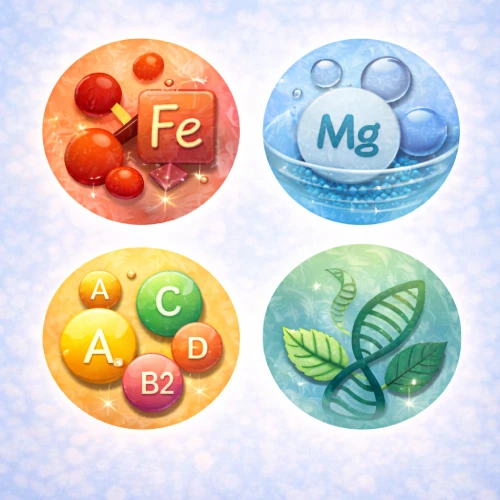
Micronutrients: invisible but essential
Unlike carbohydrates, fats, and proteins, vitamins and minerals are not structural or energetic fuels. Their role is regulatory.
They act as cofactors for enzymes, stabilizers for cellular reactions, and signals that allow systems to communicate accurately. Without enough iron, oxygen transport suffers. Without adequate magnesium, hundreds of enzymatic reactions become less efficient. Without certain vitamins, the body may have the raw materials for growth but lack the instructions to use them.
This is why micronutrient problems often present as vague symptoms. Fatigue, low resilience, slow recovery, or reduced concentration are not dramatic failures, but subtle inefficiencies accumulating over time.
Deficiency explains most benefits
One of the clearest patterns in vitamin and mineral research is this:
benefits appear strongest when something is missing.
Studies consistently show that correcting a deficiency improves function related to that nutrient. Iron deficiency affects oxygen delivery. Vitamin D deficiency influences bone metabolism and muscle function. Iodine deficiency disrupts thyroid regulation.
When baseline levels are already adequate, additional intake rarely produces measurable improvement. The body does not reward excess. It aims for balance.
This explains why large trials in generally well-nourished populations often show limited or no benefit from broad supplementation.
Absorption is not guaranteed
A tablet does not equal availability.
Minerals can compete with each other for absorption. Calcium, iron, and zinc share transport pathways. Fat-soluble vitamins depend on dietary fat and proper digestion. Gut health, inflammation, and even timing influence how much of a nutrient actually enters circulation.
This is why nutritional status cannot be inferred from intake alone. What matters is utilization, not labels.
Research reflects this complexity, which is why scientific conclusions tend to be conditional rather than absolute.

Whole foods versus isolated micronutrients
Another recurring finding in nutrition science is that vitamins and minerals behave differently when consumed as part of food.
Whole foods contain fibers, phytochemicals, and structural elements that affect digestion and metabolism. These interactions influence how micronutrients are absorbed and how they act in the body. Isolated supplementation removes that context.
This does not make supplements ineffective, but it explains why they rarely replicate the broad health associations seen with diets rich in fruits, vegetables, legumes, and minimally processed foods.
Micronutrients function best within systems, not in isolation.
Upper limits exist for a reason
Because vitamins and minerals are essential, it is easy to assume that higher intake is always safe. Evidence suggests otherwise.
Fat-soluble vitamins can accumulate. Excessive intake of certain minerals can interfere with absorption of others or stress regulatory systems. For this reason, science defines tolerable upper intake levels, not as scare tactics, but as reflections of biological limits.
The presence of these limits reinforces a core principle: micronutrients are about sufficiency, not maximization.
A better mental model
A helpful way to understand vitamins and minerals is to see them as precision components.
They do not push performance forward on their own, but they allow systems to operate as designed. When they are missing, everything downstream becomes less efficient. When they are present in adequate amounts, the system runs quietly in the background.
This is educational, not medical advice. Scientific evidence supports careful adequacy, not aggressive supplementation.
Where this understanding naturally leads
Once micronutrients are seen as regulators rather than drivers, another question emerges: how does the body prioritize resources under stress?
That question connects directly to Stress & Cortisol, where hormonal regulation explains why nutrient sufficiency alone does not guarantee optimal function.
Scientific Sources
Maughan RJ, Burke LM, Dvorak J, Larson-Meyer DE, Peeling P, Phillips SM, Rawson ES, Walsh NP, Garthe I, Geyer H, Meeusen R, van Loon LJC, Shirreffs SM, Spriet LL, Stuart M, Vernec A, Currell K, Ali VM, Budgett R, Ljungqvist A, Mountjoy M, Pitsiladis Y, Soligard T, Erdener U, Engebretsen L (2018). IOC Consensus Statement: Dietary Supplements and the High-Performance Athlete.
https://pubmed.ncbi.nlm.nih.gov/29540367/
King JC (2001). Effect of Reproduction on the Bioavailability of Calcium, Zinc and Selenium.
https://pubmed.ncbi.nlm.nih.gov/11285354/