
Leg Muscles
Leg muscles are responsible for producing the greatest amounts of force in the body, yet they are often simplified as “just squats and lunges.” In reality, the legs are a coordinated system of large muscles that create movement, absorb force, and stabilize the entire body.
This page explains the basic anatomy of the leg muscles, what each group contributes to movement, and why understanding leg anatomy matters in bodybuilding.
This content is educational, not medical advice.
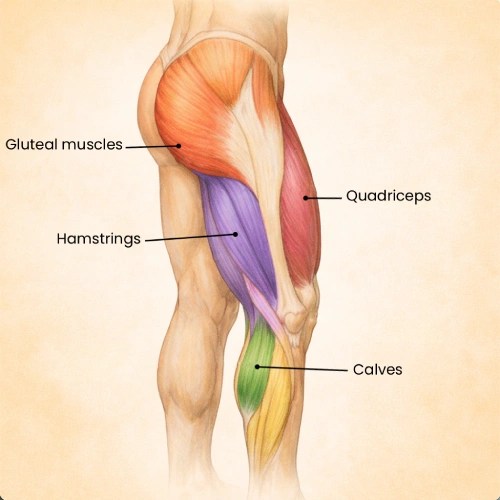
What Muscles Make Up the Legs?
In bodybuilding, the legs are usually discussed as several major muscle groups rather than a single unit.
The primary groups include:
- Quadriceps – front of the thigh
- Hamstrings – back of the thigh
- Gluteal muscles – hips and rear
- Adductors – inner thigh
- Calves – lower leg muscles
Each group has a different role depending on joint movement and body position.
Quadriceps – Knee Extension and Control
The quadriceps are a group of four muscles located on the front of the thigh.
Their main role is to:
- Straighten the knee
- Control knee bending under load
They are heavily involved when standing up from a bent position or resisting downward movement. Because of their size and leverage, quadriceps contribute significantly to overall leg strength and visual thigh development.
Hamstrings – More Than Knee Bending
Hamstrings sit on the back of the thigh and cross both the hip and knee joints.
They assist with:
- Bending the knee
- Extending the hip
- Controlling speed during movement
Because they span two joints, hamstring involvement changes depending on hip angle and torso position. This is why different movements emphasize them differently.
Glutes – Force and Stability
The gluteal muscles are among the strongest muscles in the body.
They contribute to:
- Hip extension
- Pelvic stability
- Force transfer between upper and lower body
Glutes play a major role in standing, walking, and lifting heavy loads. Their function goes beyond appearance; they influence posture, balance, and power production.
Adductors – The Often Ignored Group
Adductors are located on the inner thigh and help:
- Bring the legs toward the body’s midline
- Stabilize the hips during movement
Although less visible, they are highly active during many leg movements. Weakness or fatigue here can affect overall leg coordination without obvious warning signs.
Calves – Force Transmission, Not Just Size
Calf muscles control ankle movement and help transfer force from the legs to the ground.
They assist with:
- Standing balance
- Walking and running
- Stabilizing the lower leg during loaded movement
Because calves work constantly during daily activity, they often respond differently to training compared to larger leg muscles.
How Leg Muscles Work Together
Leg muscles rarely act in isolation.
During most lower body movements:
- Hips, knees, and ankles move together
- Multiple muscle groups share the load
- Stabilizing muscles work continuously
This coordination explains why leg fatigue can feel systemic rather than localized to one muscle.
Why Leg Anatomy Matters in Bodybuilding
Without anatomical awareness, leg training often becomes uneven.
Understanding leg muscles helps explain:
- Why some movements feel quad dominant
- Why others shift effort toward hips or glutes
- Why balance and stability affect performance
Leg anatomy turns lower body training from guesswork into interpretation.
A Useful Mental Reframe
Instead of asking:
- “Which leg exercise is best?”
A more useful question is:
- “Which joints are moving here, and which muscles are responsible?”
This reframing reduces confusion and builds long term understanding.
Leg muscles are powerful, complex, and highly cooperative.
Understanding their structure and roles makes lower body training clearer, more intentional, and easier to evaluate over time.If you want, the next natural continuation is Core Muscles, where stability becomes the foundation for everything the legs do.