
What Supplements Really Do
A science-based look at what happens inside the body
Supplements are often discussed as if they do something on their own. In reality, they behave more like inputs than actions. They provide isolated nutrients or compounds, and the body decides whether, how, and to what extent those inputs matter.
This article is educational, not medical advice. It explains what supplements are and why their effects are often limited, variable, or misunderstood, using peer-reviewed scientific evidence.

Why supplements exist at all
From a biological perspective, supplements exist because nutrition in real life is imperfect.
Human physiology evolved to work with food, sunlight, and seasonal availability. Modern lifestyles can disrupt that balance. Some people consistently consume fewer micronutrients than recommended, while others experience higher demands due to age, physical stress, or limited dietary variety.
Research suggests that supplements show the clearest benefit when they correct an existing inadequacy. In populations that already meet nutrient needs, additional intake rarely produces measurable improvement. This pattern appears repeatedly across vitamin and mineral studies.
What actually happens after ingestion
Once consumed, a supplement enters the same metabolic system as nutrients from food. There is no separate “supplement pathway.”
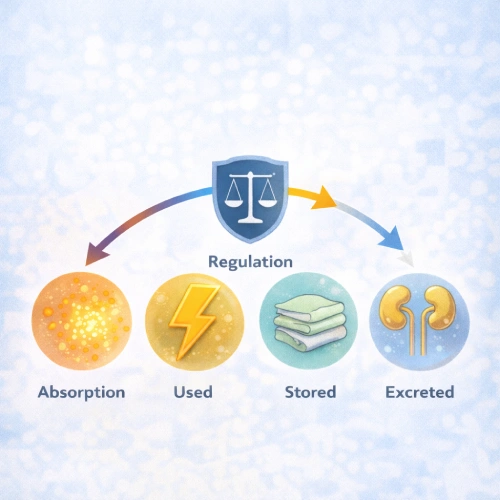
Absorption is the first limiting step. Different chemical forms of the same nutrient can be absorbed at different rates, and absorption itself depends on gut health, other nutrients present, and individual variation. After absorption, the body regulates distribution tightly. Some nutrients are used immediately, some are stored, and some are excreted.
Water-soluble vitamins are generally not stored long term, which is why excess intake often leads to urinary loss. Fat-soluble vitamins can accumulate in tissues, which explains both their usefulness in deficiency states and their potential risk at high intakes.
Supplements do not override regulation. They enter a system that prioritizes balance over excess.
Why results are often small or inconsistent
Many people expect supplements to produce noticeable effects quickly. Scientific evidence suggests that this expectation does not align well with human biology.
If baseline nutrient status is adequate, adding more does not necessarily change physiological outcomes. The body operates on sufficiency thresholds rather than linear gains. Once those thresholds are met, additional intake often yields diminishing or negligible returns.
This is one reason why large studies frequently report mixed or modest effects. Benefits tend to cluster in groups with low initial levels, while well-nourished participants show little change.
Isolated nutrients versus whole foods
A critical distinction in nutrition science is the difference between isolated compounds and whole foods.
Foods contain complex combinations of nutrients, fiber, and bioactive substances that interact within the body. These interactions, sometimes referred to as food synergy, cannot be fully replicated by isolated supplements. Research consistently shows that diets rich in whole foods are associated with better long-term health outcomes than reliance on single-nutrient interventions.
Supplements can address specific gaps, but they do not reproduce the full biological effects of eating patterns.

Safety and the problem with “more”
Another consistent finding in the literature is that higher intake does not automatically mean better outcomes.
Excessive supplementation can disturb nutrient balance, interfere with absorption of other nutrients, or lead to accumulation beyond safe levels. This is why upper intake limits exist for many vitamins and minerals, even though they are essential.
Scientific language around supplements remains cautious for this reason. Studies describe probabilities, associations, and risk ranges rather than guarantees.
How to think about supplements
A research-aligned way to understand supplements is to see them as context-dependent.
They matter most when there is a mismatch between what the body requires and what the diet reliably provides. They supply components, not outcomes. The body integrates them according to need, regulation, and environment.
This is educational, not medical advice. Understanding supplements as biological inputs rather than shortcuts aligns most closely with what current evidence shows.

Supplements operate within the body’s regulatory systems, not above them.
Their absorption, transport, and effectiveness all depend on how well the internal environment is maintained.Once this becomes clear, attention naturally shifts away from individual nutrients toward the medium that carries and regulates them.
Hydration influences circulation, cellular signaling, digestion, and even how nutrients are utilized.Seen this way, the next logical layer is Hydration & Performance, where the focus moves from what the body receives to how the body manages balance and internal conditions.
Scientific Sources
Maughan RJ, Burke LM, Dvorak J, Larson-Meyer DE, Peeling P, Phillips SM, Rawson ES, Walsh NP, Garthe I, Geyer H, Meeusen R, van Loon LJC, Shirreffs SM, Spriet LL, Stuart M, Vernec A, Currell K, Ali VM, Budgett R, Ljungqvist A, Mountjoy M, Pitsiladis Y, Soligard T, Erdener U, Engebretsen L. (2018). IOC Consensus Statement: Dietary Supplements and the High-Performance Athlete.
https://pubmed.ncbi.nlm.nih.gov/29540367/
Bailey RL, Gahche JJ, Lentino CV, Dwyer JT, Engel JS, Thomas PR, Betz JM, Sempos CT, Picciano MF. (2011). Dietary Supplement Use in the United States, 2003–2006.
https://pubmed.ncbi.nlm.nih.gov/21178089/