
Carbohydrates Explained
Carbohydrates are often reduced to labels like “good” or “bad.” From a biological perspective, they are neither. Carbohydrates are a primary energy source that influences training performance, recovery quality, and how the body manages stress.
This page explains what carbohydrates do, why they matter for muscle growth, and where common misunderstandings come from, without giving diet plans or instructions.
This content is educational, not medical advice.

What Carbohydrates Actually Are
Carbohydrates are molecules the body breaks down into glucose.
Glucose is used to:
- Fuel muscular contractions
- Support the nervous system
- Replenish stored energy inside muscles and liver
When not immediately needed, glucose is stored as glycogen, a readily available energy reserve that becomes especially relevant during resistance training.
Carbohydrates are about energy access, not fat gain by default.
Why Carbohydrates Matter for Training Performance
Resistance training relies heavily on glycogen.
Research shows that when muscle glycogen is low:
- Force output can decline
- Training volume may drop
- Perceived effort increases
This does not mean carbohydrates create muscle growth directly. It means they support the quality of the training signal by allowing harder and more consistent work.
Better training quality creates a clearer adaptation signal.
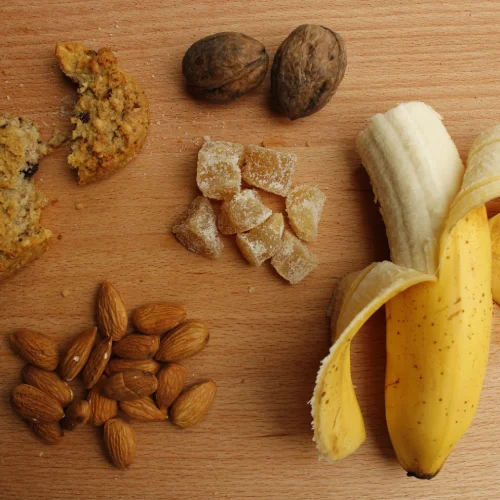
Simple vs Complex Carbohydrates – Why the Labels Confuse People
Carbohydrates are often divided into simple and complex types.
Biologically, the key differences relate to:
- Digestion speed
- Fiber content
- Blood glucose response
These differences influence how quickly energy becomes available, not whether a carbohydrate is inherently good or bad.
Context matters more than labels.
Carbohydrates and Body Composition
Carbohydrates do not automatically lead to fat gain.
Body composition changes depend on overall energy balance, training stimulus, and recovery. Carbohydrates influence how energy is used, not the direction of change by themselves.
Research suggests that carbohydrates can support muscle retention and performance even during periods of reduced energy intake, when managed appropriately.
Why Carbohydrates Are Often Feared
Carbohydrates fluctuate body weight through glycogen and water storage.
This can:
- Temporarily increase scale weight
- Change muscle fullness
- Affect how lean someone looks
These short term changes are often misinterpreted as fat gain. In reality, they reflect normal energy storage, not tissue gain.
Understanding this reduces unnecessary restriction.
Carbohydrates and the Nervous System
Glucose is also critical for brain function.
Low carbohydrate availability can:
- Increase perceived effort
- Reduce focus and coordination
- Make training feel harder than it is
This is why training quality often declines before physical exhaustion when energy availability is low.
Carbohydrates support both muscles and mindset.
A Clear Way to Think About Carbohydrates
Instead of asking:
- “Should I eat carbs?”
A more useful question is:
- “Do I have enough available energy to train and recover consistently?”
This reframes carbohydrates as performance support, not a moral choice.
Why Understanding Carbohydrates Matters
When carbohydrates are misunderstood, people often:
- Attribute fatigue to poor motivation
- Reduce intake unnecessarily
- Struggle with consistency
Understanding their role clarifies why energy availability influences performance long before visible changes occur.
Carbohydrates do not build muscle on their own.
They determine whether training can be performed and repeated with quality.Once carbohydrates are understood this way, energy stops being the enemy and starts becoming a resource.
If you want, the next natural continuation is Fats & Hormones, where long term regulation and recovery take center stage.
Selected Scientific Reading
Only a small number of references are needed to support these concepts:
Burke LM, Hawley JA, Wong SH, Jeukendrup AE (2011). Carbohydrates for Training and Competition.
https://pubmed.ncbi.nlm.nih.gov/21660838/
Hawley JA, Schabort EJ, Noakes TD, Dennis SC (1997). Carbohydrate-Loading and Exercise Performance: An Update.
https://pubmed.ncbi.nlm.nih.gov/9291549/