
Muscle Anatomy Basics
To understand bodybuilding, it helps to understand what muscles are and how they work. Muscle anatomy is not about memorizing names or diagrams. It is about recognizing how structure influences function, and why certain movements feel the way they do.
This page explains the basic structure of skeletal muscles, how they produce force, and why anatomy matters for training awareness.
This content is educational, not medical advice.
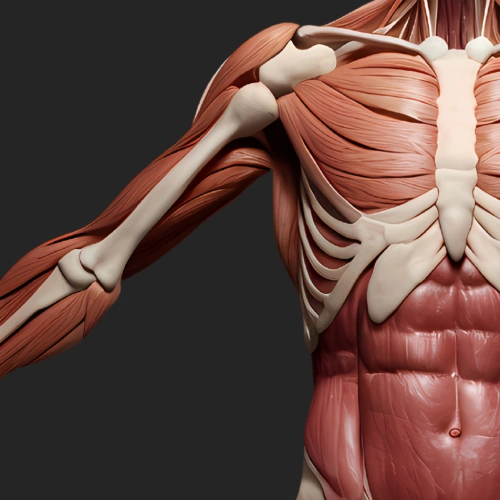
What We Mean by Muscle Anatomy
In bodybuilding, muscle anatomy usually refers to skeletal muscles. These are the muscles you consciously control to move your body and lift external loads.
Skeletal muscles are attached to bones through tendons. When they contract, they pull on bones and create movement around joints. This simple mechanism underlies every exercise, from a curl to a squat.
Understanding this relationship helps explain why:
- Joint position changes muscle involvement
- Range of motion matters
- Technique influences which muscles feel the load
The Basic Structure of a Muscle
A skeletal muscle is made up of multiple layers.
At a simplified level:
- A whole muscle contains many muscle bundles
- Each bundle contains muscle fibers
- Each fiber contains smaller contractile units
These contractile units shorten when activated, producing force. The more fibers involved and the more forcefully they contract, the greater the output.
Muscle size increases when these fibers adapt by becoming thicker over time.
Muscle Fibers and Force Production
Muscle fibers are long cells designed to generate tension.
When the nervous system sends a signal:
- Fibers shorten
- Force is produced
- Movement occurs if resistance is overcome
Not all fibers activate at once. The body recruits fibers based on effort demand. As effort increases, more fibers are recruited to help complete the task.
This explains why challenging sets feel different from easy ones.
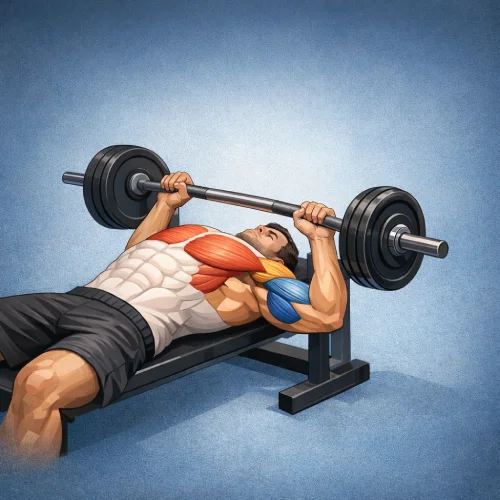
How Muscles Work Together
Muscles rarely work in isolation.
During most movements:
- One muscle acts as the primary mover
- Others assist as synergists
- Some stabilize joints or control movement speed
For example, pressing movements involve the chest, shoulders, and arms working together. Understanding this cooperation helps explain why fatigue is sometimes felt outside the target muscle.
Anatomy shows us that training is a systemic activity, not a single muscle event.
Muscle Length and Tension
Muscle force is influenced by length.
At certain lengths, muscles can produce more tension. At others, force output decreases. Joint angle and range of motion change muscle length and therefore influence how hard a muscle works.
This is why:
- Some parts of a lift feel harder than others
- Different exercises emphasize different portions of a muscle
Anatomy explains these sensations without needing complex formulas.
Why Anatomy Matters for Bodybuilding
Without anatomical understanding, training becomes guesswork.
Knowing basic anatomy helps you:
- Interpret how exercises load muscles
- Understand why form adjustments change muscle feel
- Avoid chasing sensations that do not reflect real stimulus
It shifts training from imitation to awareness.
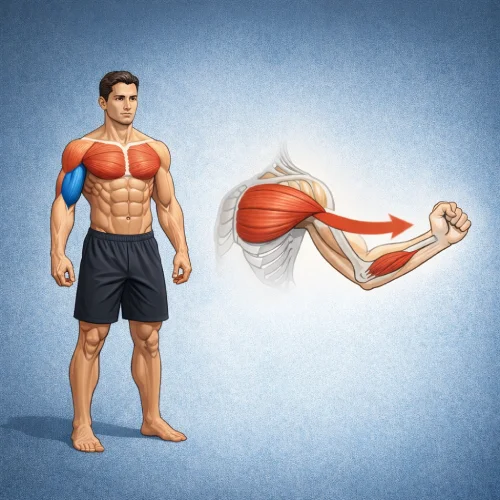
A Clear Mental Model
Instead of thinking:
- “Which exercise hits this muscle best?”
A more useful question is:
- “How does this muscle produce force, and how is it being challenged here?”
This mindset leads to better learning and fewer misconceptions.
Where Anatomy Fits in the Bigger Picture
Muscle anatomy does not replace training principles. It supports them.
It helps connect:
- Training science
- Movement quality
- Mind muscle connection
Understanding anatomy makes later topics, like specific muscle groups and exercise mechanics, easier to grasp.
Muscle anatomy is not about complexity.
It is about clarity.Once you understand how muscles are built and how they create movement, training becomes easier to interpret and harder to misunderstand.
If you want, the next step is breaking anatomy down by regions, starting with Chest Muscles or Back Muscles, where these basics become practical.