
Back Muscles
Back muscles are involved in almost every upper body movement, yet they are among the least understood. Many people train their back without clearly knowing which muscles are working, what those muscles actually do, or why certain movements feel harder than others.
This page explains the basic anatomy of the back muscles, how they function during resistance training, and why understanding them matters for bodybuilding awareness.
This content is educational, not medical advice.
What We Mean by “Back Muscles”
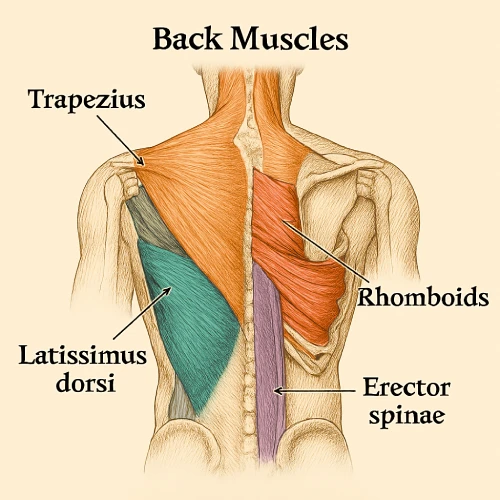
The back is not a single muscle. It is a group of muscles with different roles, layered from superficial to deep.
In bodybuilding discussions, the back mainly includes:
- Latissimus dorsi – large muscles on the sides of the back
- Trapezius – upper and mid-back muscles involved in shoulder movement
- Rhomboids – muscles between the shoulder blades
- Erector spinae – muscles that support and extend the spine
Each of these contributes differently to movement and posture.
What Back Muscles Actually Do
Back muscles are primarily responsible for:
- Pulling the arms toward the body
- Controlling shoulder blade movement
- Stabilizing the spine and torso
Unlike chest muscles, which push, the back muscles mostly pull, retract, and stabilize. This is why back training often feels less obvious and more technical.
Back muscles are heavily involved in movements where the arms move downward or backward, especially against resistance.
Why Back Muscles Are Hard to “Feel”
Many people struggle to feel their back muscles working. This is not a lack of effort. It is anatomy.
Reasons include:
- Back muscles do not shorten in a visually obvious way
- Movement often occurs at the shoulder, not the spine
- The arms and grip can fatigue before the back
Understanding this helps separate sensation from effectiveness.

The Role of the Lats
The latissimus dorsi is the largest back muscle and plays a major role in back width.
Its main actions include:
- Drawing the arms downward
- Bringing the arms closer to the torso
- Assisting in shoulder extension
Because of its size and attachment points, the lats respond strongly to movements where the arms travel from overhead or forward positions toward the body.
Upper Back and Shoulder Blade Control
Upper back muscles are heavily involved in scapular movement.
They help:
- Pull the shoulder blades together
- Control shoulder positioning
- Support posture during loaded movements
These muscles are less about moving weight and more about controlling movement. This is why upper back fatigue often shows up as posture breakdown rather than immediate failure.
The Back as a Stabilizing System
Not all back muscles create visible movement.
The erector spinae work mostly to:
- Maintain spinal position
- Resist unwanted flexion
- Transfer force between upper and lower body
They are active in many exercises even when the back does not appear to move. Anatomy explains why back fatigue can occur even during leg or hip dominant movements.
Why Back Anatomy Matters in Bodybuilding
Without anatomical awareness, back training often becomes vague.
Understanding the back helps you:
- Interpret pulling movements more clearly
- Understand why different exercises emphasize different areas
- Avoid relying only on grip or arm strength
Back development is not about finding one perfect exercise. It is about understanding how different muscles contribute to pulling and stabilization.

A Useful Mental Shift
Instead of asking:
- “Why don’t I feel my back?”
A more useful question is:
- “Which part of my back is responsible for this movement?”
This shift turns confusion into curiosity.
Back muscles are complex, not mysterious.
Once their roles are clear, back training becomes easier to interpret and harder to misjudge.If you want, the next logical continuation is Shoulder Muscles, where stability and mobility intersect even more closely.