
Protein Powders
What they are, what they provide, and what they do not change
Protein powders are often framed as essential tools for muscle growth. In reality, they are neither magic nor mandatory. They are processed food products designed to deliver protein in a concentrated, convenient form. Their relevance depends on context, not status.
This article is educational, not medical advice. It explains what protein powders actually are, how the body handles them, and why scientific evidence treats them as optional rather than foundational.
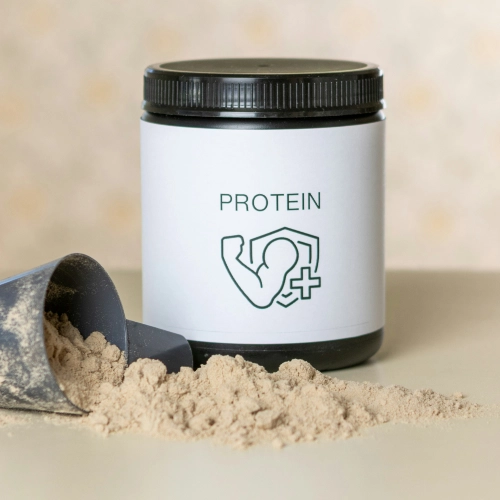
What protein powders actually are
At a biochemical level, protein powders are sources of amino acids.
They are derived from foods such as milk (whey, casein), plants (soy, pea, rice), or eggs, then processed to remove most fats and carbohydrates. What remains is a dense protein source that the body digests similarly to protein from whole foods.
Once consumed, protein powders are broken down into amino acids in the digestive tract. These amino acids enter circulation and become part of the same amino acid pool used for tissue repair, enzyme production, hormone synthesis, and muscle protein turnover.
The body does not recognize “powder” versus “food.” It recognizes amino acids.
Protein intake and muscle adaptation
Muscle tissue is constantly being broken down and rebuilt. Protein provides the building blocks for this process, but it does not initiate growth by itself.
Research shows that resistance training is the primary signal for muscle adaptation. Protein availability supports the rebuilding phase that follows. When protein intake is insufficient, adaptation may be limited. When intake is adequate, additional protein does not necessarily accelerate results.
This explains why studies often find that protein supplementation benefits individuals with low baseline intake, while showing minimal added effect in those already meeting their needs through diet.
Protein powders do not “turn on” muscle growth. They support recovery processes that training already triggers.
Absorption speed and common misunderstandings
One frequently discussed aspect of protein powders is digestion speed.
Some proteins are absorbed relatively quickly, others more slowly. While this affects short-term amino acid availability, research suggests that total daily protein intake matters more than precise timing for most people.
The idea of a narrow “anabolic window” has largely been softened by evidence showing that muscle protein synthesis remains responsive for many hours after training, especially when overall intake is sufficient.
Protein powders are often used for convenience, not because they are biologically superior.
Whole foods versus protein powders
Protein powders differ from whole foods in more than texture.
Whole foods provide additional nutrients such as fiber, micronutrients, and bioactive compounds that powders usually lack. These components contribute to digestion, satiety, and long-term health in ways isolated protein cannot replicate.
Scientific literature consistently shows that diets built around whole foods are associated with better health outcomes. Protein powders can help close intake gaps, but they do not replace the broader nutritional matrix of real meals.

Who may benefit, and who may not
Protein powders tend to be most relevant when dietary protein is difficult to obtain consistently. This may occur due to limited appetite, restricted food choices, or high energy demands.
Conversely, individuals already consuming adequate protein through regular meals often see little measurable difference when adding protein powders. The body responds to sufficiency, not surplus.
This variability explains why protein powder research emphasizes context rather than universal need.
Safety and long-term perspective
In healthy individuals, protein powders consumed within studied intake ranges are generally considered safe. However, excessive protein intake does not guarantee better outcomes and may displace other important nutrients if it crowds out balanced meals.
Protein powders are tools of convenience, not requirements of physiology.
Scientific language around them reflects this reality: evidence suggests usefulness in specific scenarios, not dependency.
How to think about protein powders
Protein powders are best understood as logistical solutions.
They simplify protein intake when food access, time, or appetite makes meeting needs difficult. They do not override training quality, energy balance, or recovery. They contribute materials, not direction.
This is educational, not medical advice.
Where this understanding naturally leads
Protein powders highlight a broader nutritional principle: nutrients support adaptation only when overall energy intake allows it. Protein cannot be used effectively if total calories are insufficient.
From here, the next logical layer is Calories & Energy Balance, where muscle growth is examined not as a single-nutrient issue, but as a systemic energy-driven process.
Scientific Sources
Morton RW, Murphy KT, McKellar SR, Schoenfeld BJ, Henselmans M, Helms E, Aragon AA, Devries MC, Banfield L, Krieger JW, Phillips SM (2018). A Systematic Review, Meta-Analysis and Meta-Regression of the Effect of Protein Supplementation on Resistance Training-Induced Gains in Muscle Mass and Strength in Healthy Adults.
https://pubmed.ncbi.nlm.nih.gov/28698222/
Phillips SM, Van Loon LJC (2011). Dietary Protein for Athletes: From Requirements to Optimum Adaptation.
https://pubmed.ncbi.nlm.nih.gov/22150425/