
How Muscles Grow (Simple Science)
Muscle growth may look complex, but the underlying process follows clear biological rules. Muscles do not grow because of a specific exercise or routine. They grow because the body adapts to repeated mechanical stress over time.
This page explains how muscles grow and why they grow, using simple science and clear language.
This content is educational, not medical advice.
Muscle Growth Begins With Mechanical Stress
Muscle growth starts when muscle tissue is exposed to mechanical tension that exceeds what it is accustomed to.
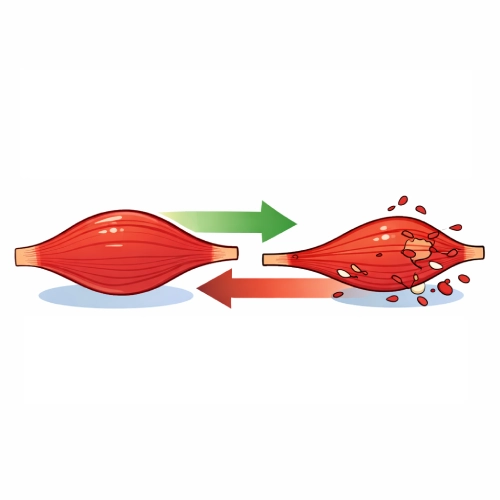
During resistance training, this tension creates microscopic disruptions within muscle fibers. Research shows that these disruptions act as biological signals, triggering the body to adapt and reinforce the stressed tissue.
The goal of this adaptation is not appearance, but protection and efficiency:
to better tolerate similar stress in the future.
Muscle Protein Synthesis and Breakdown
At the cellular level, muscle size is regulated by the balance between two ongoing processes:
- Muscle protein synthesis
- Muscle protein breakdown
After resistance training, protein synthesis increases for a period of time. When synthesis consistently exceeds breakdown, muscle tissue gradually increases in size.
Studies suggest that this balance is influenced by training stimulus, recovery quality, and overall energy availability.
Importantly, muscle growth does not occur during training itself. It occurs during recovery, when the body rebuilds stressed tissue.
Why Muscle Growth Is Slow
Many people expect muscle growth to be fast because strength often improves quickly. These are not the same process.
Early strength gains are largely driven by neurological adaptations, such as improved motor unit recruitment. Muscle hypertrophy, however, requires structural changes to tissue, which take more time and resources.
Research indicates that meaningful increases in muscle size occur over weeks and months, not days.
Consistency Signals Adaptation
The body responds to patterns, not isolated events.
One workout does not justify building new muscle tissue. Repeated exposure to resistance training sends a clearer biological message:
this demand is ongoing.
Studies consistently show that long-term consistency plays a larger role in muscle growth than short-term intensity spikes.
Recovery Is Not Optional
Muscle growth depends as much on recovery as on training.
During rest periods:
- Inflammation decreases
- Protein synthesis occurs
- Energy systems stabilize
Research suggests that insufficient recovery and chronic fatigue can limit muscle growth, even when training effort is high. The body prioritizes survival before adaptation.

Individual Differences in Muscle Growth
Muscle growth is influenced by multiple factors, including genetics, training history, age, and lifestyle. Research shows that individuals respond differently to the same stimulus.
This explains why comparisons between individuals often lead to confusion. Muscle growth reflects personal biology, not effort alone.
Why This Understanding Matters
When muscle growth is misunderstood, people often:
- Chase shortcuts
- Overtrain
- Misinterpret plateaus
- Lose motivation unnecessarily
Understanding how muscle tissue adapts at a biological level also clarifies why different training approaches lead to different outcomes.
Once growth mechanisms are clear, the next question becomes how strength-focused and size-focused adaptations overlap and diverge in practice.That relationship is explored in Strength vs Muscle Growth, where training outcomes are examined through their underlying physiological priorities rather than surface results.
Further Reading & Scientific Sources
For readers who want to explore the science in more detail, the following sources provide strong evidence-based explanations:
- Schoenfeld, B. J. (2010). The mechanisms of muscle hypertrophy and their application to resistance training.
https://pubmed.ncbi.nlm.nih.gov/20847704/ - Phillips, S. M., & Van Loon, L. J. C. (2011). Dietary protein for athletes: From requirements to metabolic advantage.
https://pubmed.ncbi.nlm.nih.gov/22150425/