
Scale Weight vs Mirror
In bodybuilding, progress is often reduced to a single question: What does the scale say? At the same time, many people trust the mirror more than numbers. Both signals provide information, but neither tells the full story on its own.
This content explains why scale weight and visual appearance often disagree, what each one reflects, and how to interpret them without treating either as absolute truth.
This content is educational, not medical advice.
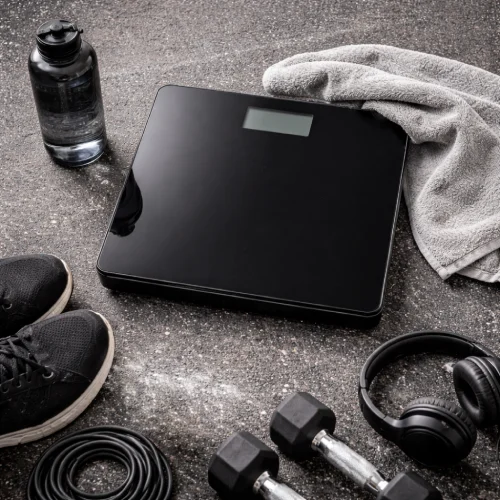
What the Scale Actually Measures
Scale weight represents total body mass at a given moment. It includes muscle, fat, water, glycogen, food content, and short-term fluid shifts.
Because of this, scale changes can occur without any structural change in the body. Weight may increase or decrease due to:
- Hydration status
- Glycogen storage
- Digestive contents
- Temporary inflammation from training
The scale is sensitive, but it is not specific. It detects change without explaining its source.
What the Mirror Reflects Instead
The mirror does not measure mass. It reflects shape, proportion, and visual contrast.
Appearance is influenced by:
- Fat distribution
- Muscle size and separation
- Posture and muscle tone
- Lighting and viewing angle
These factors can change even when scale weight stays the same. This is why visible progress often appears before numbers confirm it.
Why the Two Signals Commonly Conflict
It is common for the scale and the mirror to move in opposite directions.
Examples include:
- Weight increases while definition improves
- Weight stays stable while the body looks leaner
- Weight drops while muscle fullness decreases
These situations occur because scale weight and appearance respond to different variables and operate on different timescales.
Research suggests that short-term body weight fluctuations are often driven by water and glycogen changes rather than changes in fat or muscle tissue.
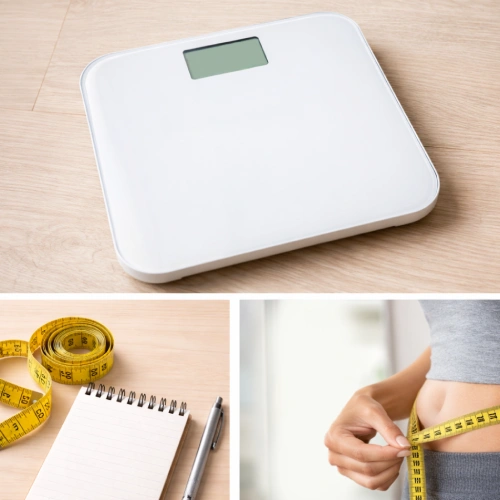
When the Scale Becomes Misleading
The scale becomes most misleading when it is used in isolation.
Daily weighing can amplify normal variation and create false narratives of progress or failure. Small changes may feel significant even when they fall within normal physiological fluctuation.
Without context, scale weight tends to reflect noise rather than adaptation.
When the Mirror Can Also Deceive
While the mirror often captures meaningful change, it is not immune to distortion.
Visual assessment can be influenced by:
- Temporary pump or fatigue
- Mood and expectation
- Comparison to recent images rather than long-term trends
Appearance can fluctuate without real change, especially when viewed too frequently.
Using Both Signals Together
Scale weight and visual appearance are most useful when interpreted together rather than in competition.
When both move in the same direction over time, progress is usually clear. When they conflict, additional context becomes necessary rather than immediate conclusions.
This combined view reduces overreaction and supports more accurate interpretation.
Why Context Matters More Than Either Signal
Neither the scale nor the mirror was designed to judge progress alone. Each provides partial information.
Progress becomes clearer when these signals are considered alongside:
- Training performance
- Recovery quality
- Longer-term trends
Understanding how and why these signals differ helps explain why progress sometimes feels invisible before it becomes obvious.
This perspective aligns naturally with how physical change is interpreted in Measuring Progress Correctly and how composition shifts are discussed in Weight vs Muscle Gain.
This content is educational, not medical advice.
Scientific Sources
Gallagher D, Heymsfield SB, Heo M, Jebb SA, Murgatroyd PR, Sakamoto Y (2000). Healthy Percentage Body Fat Ranges: An Approach for Developing Guidelines Based on Body Mass Index.
https://pubmed.ncbi.nlm.nih.gov/10966886/
Schoenfeld BJ (2010). The Mechanisms of Muscle Hypertrophy and Their Application to Resistance Training.
https://pubmed.ncbi.nlm.nih.gov/20847704/