
Tempo and Control
Tempo and control are often discussed as technical preferences, but they primarily describe how force is applied over time. They influence where effort is concentrated, how fatigue accumulates, and how clearly a movement can be repeated and evaluated.
Rather than being rules to follow, tempo and control shape the quality of interaction between the body and the load.

What tempo actually represents
Tempo refers to the speed at which different phases of a movement occur. This includes how quickly load is lifted, lowered, or transitioned between positions. Each phase alters mechanical demand and sensory feedback.
Changing tempo does not automatically change difficulty in a linear way. A slower movement may feel harder due to prolonged tension, while a faster movement may increase peak force demands. Both create stress, but through different mechanisms.
Control as a limiting factor
Control describes the ability to maintain intended joint paths and muscle involvement under load. When control decreases, force often shifts away from the target tissues toward compensatory patterns.
This shift does not necessarily feel obvious. Performance may still continue, but the nature of the stress changes. Over time, this makes outcomes harder to interpret because effort is no longer applied consistently.

Time under tension and perception
Longer durations within a movement phase increase sensory feedback. This can enhance awareness of effort and position, but it also increases fatigue without always increasing productive tension.
Research generally suggests that hypertrophy is not driven by slow movement alone, but by sufficient tension applied with control. Tempo influences how that tension is experienced, not whether adaptation occurs.
Acceleration and intent
Intent matters as much as visible speed. A movement performed with high intent to produce force may still appear controlled, yet place greater demand on the neuromuscular system.
This explains why two repetitions that look similar can feel very different. Control does not imply passivity; it reflects precision rather than hesitation.
Fatigue and tempo drift
As fatigue accumulates, tempo often changes unintentionally. Eccentric phases shorten, pauses disappear, and transitions become rushed. These changes alter joint loading and stress distribution.
Recognizing tempo drift helps explain why later repetitions may feel less targeted, even if the external load remains unchanged.
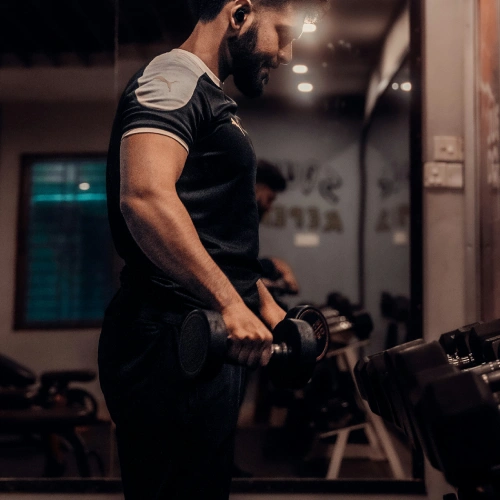
Control versus restriction
Control should not be confused with artificial restriction. Excessively constrained movements can reduce natural force expression and distort feedback.
Effective control allows movement to remain stable without becoming rigid. It preserves clarity rather than forcing uniformity.
Tempo and control influence how stress is applied within a chosen range of motion. They determine whether tension is expressed deliberately or diluted through inconsistency.
This perspective connects naturally to Mind–Muscle Connection, where awareness and intent shape internal feedback, and to Movement Quality & Biomechanics, where joint alignment and leverage further refine how control is maintained under load.
This article is provided for educational purposes only and should not be interpreted as medical guidance.
Scientific Sources
Schoenfeld BJ et al. (2015). Effects of repetition duration during resistance training on muscle hypertrophy
https://pubmed.ncbi.nlm.nih.gov/25601394/
Wilk M et al. (2018). Movement tempo and its effects on muscular strength and hypertrophy
https://pubmed.ncbi.nlm.nih.gov/29703046/