
Conditioning for Bodybuilding
Conditioning in bodybuilding is often misunderstood as something separate from muscle-focused training. In reality, it describes the body’s ability to tolerate, repeat, and recover from training stress without degrading performance or movement quality.
Rather than being a standalone activity, conditioning shapes how effectively training can be sustained over time.

What conditioning actually refers to
Conditioning reflects the efficiency of multiple systems working together: cardiovascular support, local muscular endurance, and recovery processes between efforts.
In a bodybuilding context, conditioning is not about maximal endurance or athletic performance. It is about maintaining output across repeated training exposures without excessive fatigue accumulation.
Conditioning versus aesthetics
Conditioning is sometimes conflated with visual leanness. While the terms overlap in competition language, they describe different phenomena.
Training-related conditioning concerns internal capacity, not external appearance. A well-conditioned system allows higher quality work to be performed consistently, regardless of body composition goals.
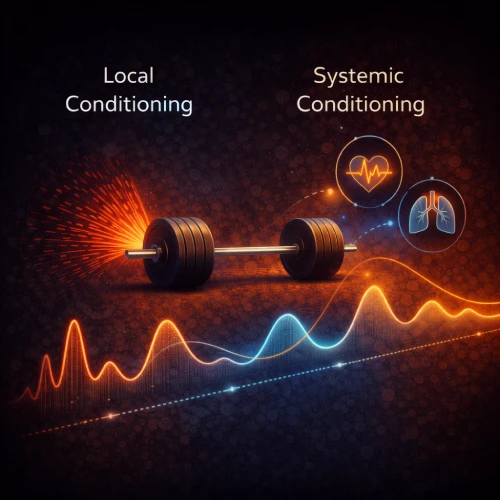
Local versus systemic conditioning
Conditioning can be expressed locally within specific muscles or systemically across the body. Local conditioning influences how long a muscle can sustain tension before performance drops. Systemic conditioning affects breathing, heart rate recovery, and overall fatigue management.
Both layers influence how training sessions feel and how repeatable they are across a week.
Why conditioning supports hypertrophy indirectly
Conditioning does not create muscle growth directly. It supports the environment in which growth-oriented stress can be applied more effectively.
Better conditioning reduces disruptive fatigue, shortens recovery between efforts, and stabilizes performance. This makes training signals clearer and more consistent over time.
Misinterpreting fatigue as poor conditioning
Fatigue is not always a sign of inadequate conditioning. Accumulated stress from training blocks, sleep disruption, or nutritional factors can all influence perceived capacity.
Understanding conditioning as context-dependent prevents overcorrection and unnecessary changes.
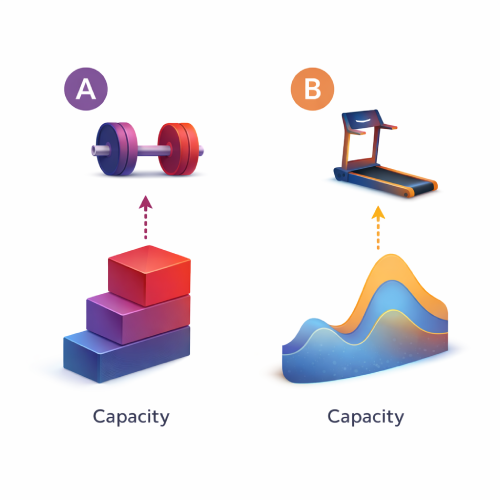
Conditioning adapts to demand
Conditioning improves in response to repeated exposure to manageable stress. It adapts specifically to the type of demand imposed.
This specificity explains why conditioning gained in one context may not fully transfer to another. Capacity is shaped by patterns, not general effort.
Conditioning as a background variable
In bodybuilding, conditioning operates in the background. When it is sufficient, it is rarely noticed. When it is limiting, it becomes highly visible through declining performance and recovery.
Viewing conditioning this way emphasizes its supportive role rather than treating it as a competing priority.
Conditioning influences how well training stress can be tolerated and expressed over time. It supports consistency without dictating outcomes.
This understanding connects naturally to Work Capacity Explained, where tolerance to workload is examined more closely, and to Cardio and the Interference Effect, where different conditioning demands interact with hypertrophy-focused training.
This article is intended for educational purposes and should not be interpreted as medical or clinical guidance.
Scientific Sources
Bishop D, Girard O, Mendez-Villanueva A (2011). Repeated-sprint ability—part II: recommendations for training
https://pubmed.ncbi.nlm.nih.gov/21311359/
Haff GG, Triplett NT (2016). Essentials of strength training and conditioning
https://pubmed.ncbi.nlm.nih.gov/27736227/