
Responders vs Non-Responders
The idea of responders and non-responders is often misunderstood as a fixed classification. In reality, it describes observed differences in how individuals adapt to a given stimulus, not permanent traits.
This distinction is descriptive, not judgmental. It reflects variability in response, not differences in effort or potential.
What “response” actually refers to
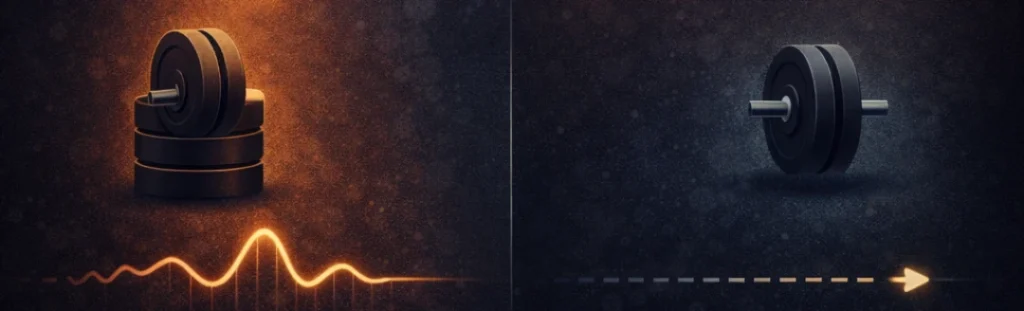
A response is a measurable change following exposure to a specific training stimulus. When a change is observed, an individual may be labeled a responder to that stimulus. When no clear change appears within a given timeframe, the term non-responder is sometimes used.
Importantly, this label applies to a context, not to the person. Response is always tied to the type, magnitude, and duration of stress applied.
Why apparent non-response occurs
Lack of visible adaptation does not necessarily indicate absence of adaptation. Changes may occur in areas that are not being measured, or they may be masked by fatigue or variability.
In many cases, a different stimulus, timeframe, or recovery context reveals responsiveness that was previously hidden.

Responsiveness is stimulus-specific
An individual may respond strongly to one type of stress and weakly to another. This variability reflects differences in physiology, motor patterns, and adaptation history.
For this reason, the term non-responder should be interpreted as “not responding to this particular stimulus under these conditions.”
The role of measurement and timing
Response is often assessed over short periods. Adaptation, however, does not always follow short timelines. Delayed or gradual changes can be misclassified as non-response if the observation window is too narrow.
Measurement sensitivity also matters. Subtle improvements may go unnoticed if metrics lack resolution.
Genetics and plasticity
Genetic factors influence baseline traits and rates of adaptation, but they do not rigidly define outcomes. Plasticity remains throughout life, though its expression varies.
This perspective avoids deterministic thinking and emphasizes that response can change as context changes.

Avoiding identity labels
Treating responder status as an identity creates unnecessary limitation. It shifts attention away from modifiable variables and toward fixed narratives.
A more useful approach treats response patterns as information guiding future decisions rather than as conclusions.
Responders and non-responders describe variation, not ceilings. They highlight how differently bodies interpret the same stress.
This understanding connects naturally to Genetics and Expectations, where variability is placed in a broader biological context, and to Individual Differences, where training age, recovery, and structure shape how response emerges over time.
This article is intended for educational purposes and should not be interpreted as medical or clinical guidance.
Scientific Sources
Hubal MJ et al. (2005). Variability in muscle size and strength gain after unilateral resistance training
https://pubmed.ncbi.nlm.nih.gov/15703112/
Bouchard C et al. (2011). Individual differences in response to regular physical activity
https://pubmed.ncbi.nlm.nih.gov/22007273/