
Genetics and Expectations
Genetics are often invoked to explain outcomes in training, sometimes as a source of reassurance and sometimes as a perceived limitation. In reality, genetics shape ranges and tendencies, not fixed results.
Understanding genetics in a neutral way helps align expectations with biological reality without reducing training to predetermined outcomes.
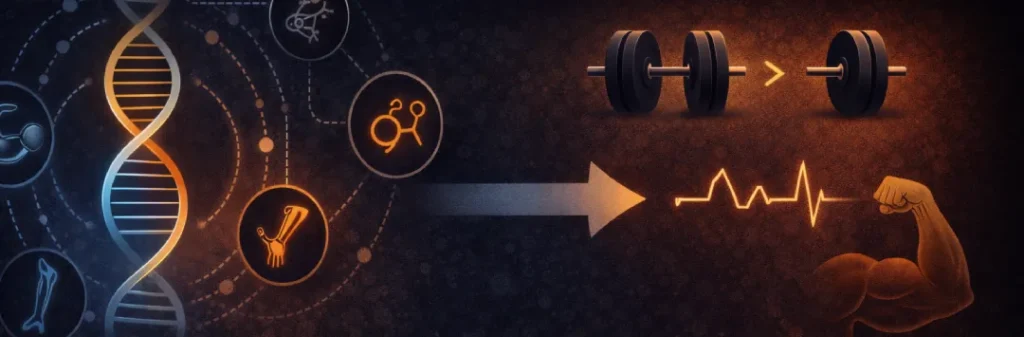
What genetics actually influence
Genetic factors influence baseline traits such as limb length, muscle fiber distribution, hormone sensitivity, and recovery tendencies. These traits affect how training stress is interpreted and expressed.
They do not dictate specific results. They influence how adaptation occurs, not whether adaptation is possible.
Variation in starting points
Individuals begin with different physical characteristics. These differences shape early progress and visual changes, often leading to comparisons that lack context.
What appears as rapid improvement in one person may reflect a favorable starting point rather than superior adaptation. Genetics influence appearance as much as performance.
Rates of adaptation, not endpoints
Genetics affect the rate at which adaptations occur. Some individuals show noticeable changes quickly, while others progress more gradually.
Slower visible change does not imply lower potential. It reflects how efficiently the body converts stimulus into observable outcomes within a given timeframe.

Expectations shape interpretation
Expectations influence how progress is perceived. When expectations are misaligned with individual tendencies, normal variation may be interpreted as failure.
A neutral understanding of genetics reframes progress as a personal trajectory rather than a comparison exercise.
Genetics and modifiable factors
Genetic influence exists alongside modifiable variables such as training structure, nutrition, recovery, and consistency. These factors interact with genetics rather than being overridden by them.
Focusing exclusively on genetics obscures the role of controllable inputs, while ignoring genetics creates unrealistic timelines.
Avoiding deterministic thinking
Viewing genetics as destiny limits decision-making. It shifts focus away from process and toward assumed ceilings.
A more productive view treats genetics as context. They inform expectations without defining identity or effort.

Genetics as part of individual differences
Genetics are one layer within broader individual differences. Training age, response patterns, and recovery capacity all interact with genetic background.
Understanding this interaction encourages patience and precision rather than comparison or resignation.
Genetics provide boundaries within which adaptation occurs, but they do not prescribe outcomes. Expectations that respect these boundaries support long-term consistency.
This perspective connects naturally to Responders vs Non-Responders, where variability in adaptation is observed, and to Training Age Explained, where exposure history shapes how genetic tendencies are expressed over time.
This article is intended for educational purposes and should not be interpreted as medical or clinical guidance.
Scientific Sources
Bouchard C et al. (2011). Individual differences in response to regular physical activity
https://pubmed.ncbi.nlm.nih.gov/22007273/
Phillips SM, Winett RA (2010). Uncomplicated resistance training and health-related outcomes
https://pubmed.ncbi.nlm.nih.gov/20168147/