
Compensations and Form Breakdowns (Educational)
Compensations and form breakdowns are often treated as errors to eliminate. In practice, they are signals. They reflect how the body responds when mechanical demands exceed available control, strength, or coordination.
Rather than viewing them purely as mistakes, they can be understood as adaptive responses to changing constraints within a movement.
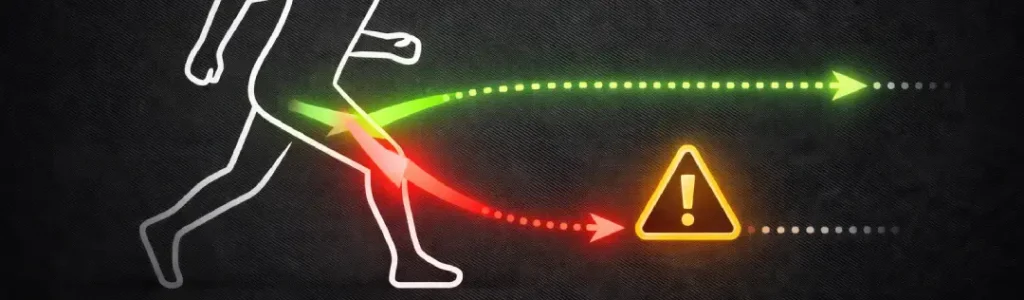
What compensation actually means
A compensation occurs when force is redistributed away from the intended path toward an alternative strategy. This shift allows the movement to continue, but it changes where stress is applied.
Compensations are not random. They follow predictable patterns shaped by joint structure, leverage, and fatigue. The body selects the most accessible option when the original strategy becomes difficult to sustain.
Why form changes under fatigue
As fatigue accumulates, force production capacity decreases. To maintain movement, the body often adjusts joint angles, tempo, or muscle contribution.
These adjustments are rarely conscious. They emerge automatically as the nervous system seeks efficiency under reduced capacity. This explains why form often changes gradually rather than collapsing suddenly.

Control versus collapse
Not all visible changes indicate loss of control. Some degree of variation is expected as effort increases. A breakdown becomes relevant when variability significantly alters joint loading or stress distribution.
Understanding this distinction prevents overcorrection and unnecessary rigidity. Movement does not need to be static to be effective.
Common sources of breakdown
Form changes often originate from leverage shifts, reduced stability, or limited tolerance at specific joint positions. When one area becomes limiting, others compensate to preserve motion.
This highlights why breakdowns frequently appear at similar points within a range of motion or late in a set, where demands are highest.
Interpreting breakdowns without alarm
Seeing compensation does not automatically imply injury risk. Context matters. Occasional adjustments under high effort differ from chronic, uncontrolled patterns repeated across sessions.
A calm interpretation focuses on what the breakdown reveals about stress distribution rather than assuming pathology.

Learning from compensation patterns
Patterns of compensation can provide insight into which aspects of a movement are most demanding. They show where force production, stability, or coordination becomes limiting.
Viewed this way, breakdowns become feedback rather than failure.
Compensations and form breakdowns reveal how the body negotiates stress when demands approach its limits. They reflect the interaction between leverage, stability, and fatigue.
This understanding connects back to Stability vs Mobility, where control and motion are balanced, and forward to Periodization & Training Cycles, where managing fatigue and variation over time influences how often breakdowns occur.
This article is provided for educational purposes only and should not be interpreted as medical guidance.
Scientific Sources
McGill SM (2010). Core training: Evidence translating to better performance and injury prevention
https://pubmed.ncbi.nlm.nih.gov/20179665/
Enoka RM, Duchateau J (2016). Translating fatigue to human performance
https://pubmed.ncbi.nlm.nih.gov/27093207/