
Stability vs Mobility
Stability and mobility are often discussed as opposing qualities, yet in movement they function as complementary roles. Every exercise expresses a balance between how much motion is allowed and how much control is required to manage that motion.
Understanding this balance helps explain why certain movements feel powerful and repeatable, while others feel unstable or inconsistent despite lighter loads.

What mobility actually represents
Mobility refers to the ability of a joint to move through its available range with control. It is not simply flexibility, but usable movement capacity.
A joint with high mobility can access more positions, but this access increases the demand for coordination. Mobility expands options, yet it also raises the requirement for control to prevent force from leaking into unwanted directions.
What stability actually represents
Stability refers to the ability to resist unwanted movement. It allows force to be expressed efficiently by providing a solid base from which motion can occur.
Stability does not imply rigidity. Effective stability permits intended motion while limiting deviations that would reduce force transfer or increase strain elsewhere.
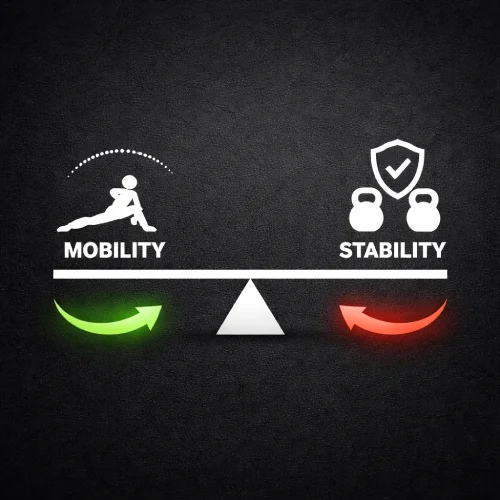
The trade-off between the two
As mobility increases, stability demands rise. As stability increases, mobility demands decrease. Exercises that emphasize large ranges of motion typically require more neuromuscular coordination, while exercises with external support reduce this requirement.
Neither side of this trade-off is inherently superior. Each creates a different stress profile and learning environment.
How this balance shapes exercise experience
Highly mobile exercises often feel less predictable. Small variations in joint position can alter leverage and force distribution, making outcomes harder to interpret.
More stable exercises tend to feel clearer and more repeatable. Because fewer variables are involved, changes in performance are easier to attribute to adaptation rather than execution differences.
Misinterpreting instability as effectiveness
Instability often increases perceived difficulty. This sensation can be mistaken for higher stimulus, even when force production is limited by balance or coordination rather than tissue loading.
Understanding this distinction helps separate how hard an exercise feels from what kind of stress it actually produces.
Context matters more than labels
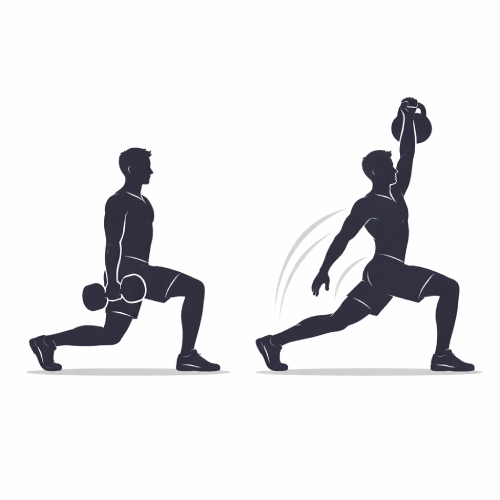
Labeling exercises as “good for stability” or “good for mobility” oversimplifies their role. The same movement can emphasize different qualities depending on load, range, and intent.
The more relevant question is how much variability the exercise introduces and whether that variability serves the training context.
Stability and mobility define how movement is controlled under load. They influence predictability, force expression, and the clarity of feedback during training.
This perspective naturally leads into Compensations and Form Breakdowns, where shifts in stability and mobility under fatigue become more visible, and back to Joint Angles & Leverage, where positioning determines how control and motion interact.
This article is provided for educational purposes only and should not be interpreted as medical guidance.
Scientific Sources
Hodges PW, Richardson CA (1996). Inefficient muscular stabilization of the lumbar spine associated with low back pain
https://pubmed.ncbi.nlm.nih.gov/8888050/
Behm DG, Anderson KG (2006). The role of instability with resistance training
https://pubmed.ncbi.nlm.nih.gov/16596763/