
Joint Angles & Leverage
Joint angles and leverage determine how force is transmitted through the body during movement. They influence which tissues bear the greatest load, how difficult a position feels, and where limitations emerge within an exercise.
Rather than being abstract biomechanical concepts, joint angles and leverage shape the practical experience of training in every repetition.
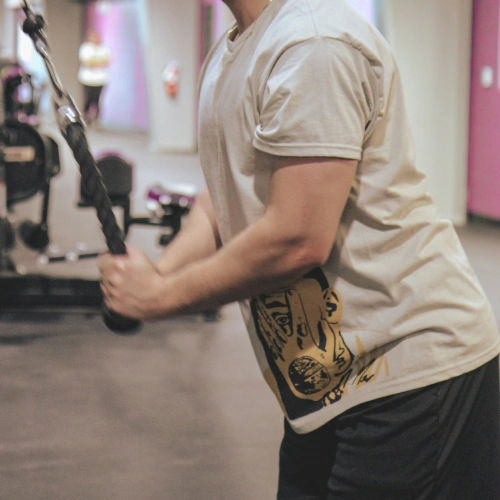
How joint angles shape force demands
A joint angle describes the relative position of two connected segments. As this angle changes, the relationship between external load and internal force also changes.
Certain positions place muscles at mechanical advantages, allowing force to be produced more efficiently. Other positions reduce leverage, increasing internal stress even when the external load remains constant. This explains why some portions of a movement feel disproportionately challenging.
Leverage and moment arms
Leverage is influenced by the distance between a joint and the line of force acting upon it. This distance, often described as a moment arm, determines how much torque a muscle must generate to move or stabilize a load.
Small changes in joint angle can significantly alter moment arms. As a result, two repetitions that appear similar externally may impose very different internal demands.
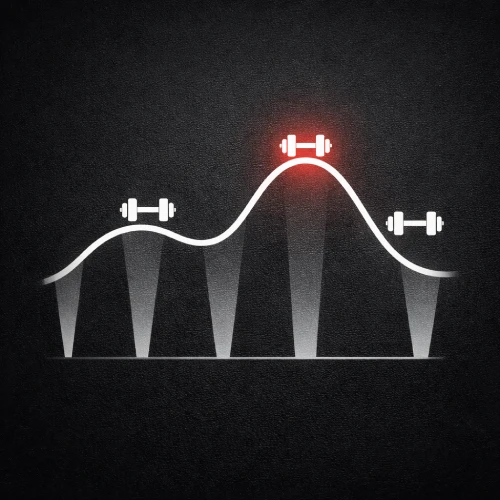
Strength curves and perceived difficulty
Most exercises do not challenge muscles evenly across the entire range of motion. Difficulty rises and falls as leverage shifts.
Understanding this helps explain why sticking points occur at predictable locations and why fatigue accumulates unevenly across a set. It also clarifies why adding load does not increase stress uniformly across all joint positions.
Individual structure and lever length
Limb length, joint structure, and segment proportions influence leverage. Individuals with different builds may experience the same exercise very differently, even when technique appears similar.
This variability is not an error to be corrected but a reality to be accounted for. Joint angles that feel efficient for one person may feel restrictive or demanding for another.
Stability and leverage interaction
Leverage does not exist in isolation. Stability requirements alter how force can be expressed at a given joint angle. When stability is reduced, potential force output often decreases, even if leverage appears favorable.
This interaction explains why externally stable exercises often feel more predictable and why unstable positions can limit effective force expression despite lighter loads.

Interpreting technique through angles
Observing joint angles provides more insight than focusing on external cues alone. Changes in posture or limb position often reflect attempts to improve leverage under fatigue.
Rather than viewing these adjustments as failures, they can be understood as adaptive responses to shifting mechanical demands.
Joint angles and leverage define where and how stress is concentrated within a movement. They help explain why exercises feel uneven, why limitations appear at specific points, and why individuals respond differently to the same task.
This understanding connects naturally to Stability vs Mobility, where joint positioning influences control, and to Compensations and Form Breakdowns, where changes in leverage under fatigue become more visible.
This article is provided for educational purposes only and should not be interpreted as medical guidance.
Scientific Sources
Enoka RM (2008). Neuromechanics of human movement
https://pubmed.ncbi.nlm.nih.gov/18381244/
Lieber RL (2002). Skeletal muscle structure and function
https://pubmed.ncbi.nlm.nih.gov/12444099/